F E S T I V A L / FEST-244
Toshijima Hachiman Festival (Jinsai)
答志島 八幡祭(神祭)とうしじま はちまんさい
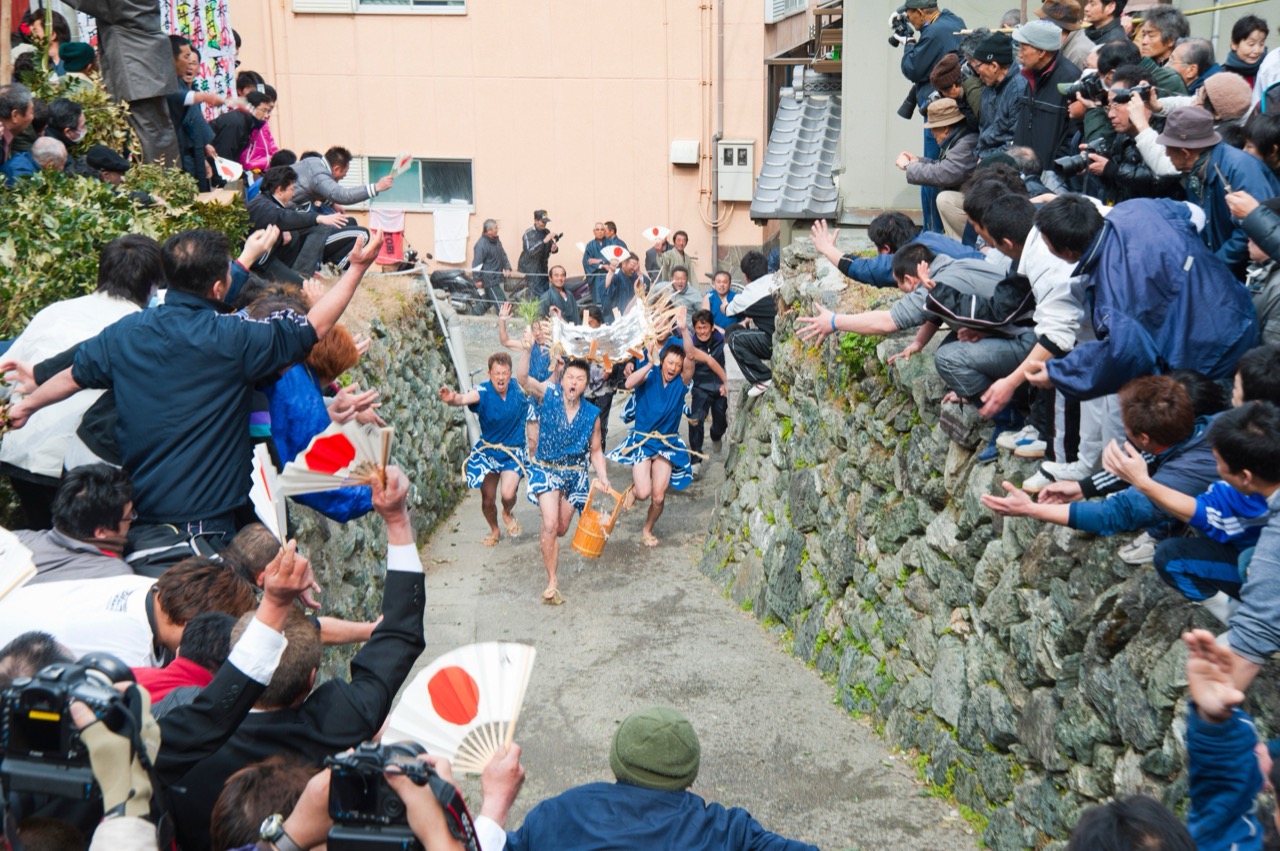
On Toshijima, the largest island in Ise Bay, the lunar new year brings the Hachiman Festival — known locally simply as the 'Jinsai' (god festival) — a men's rite at Hachiman Shrine whose climax is an archery ritual followed by a violent scramble for ink. Young men called the 'otomato-shu' shoulder a huge target the size of a tatami-and-a-half, smeared with black ink, and charge up a stone-walled lane; townspeople hurl themselves at it and tear away the ink-soaked paper. With that stolen ink they paint the shrine's crest — 'maru-hachi,' the character for eight inside a circle — on their doors, household altars, and boats, praying for a great catch, household safety, and safe passage at sea. The '○八' mark covers the island: homes, shops, factories, even the school. Toshijima is also famous as the last place in Japan to keep the 'neyako' system, in which boys live communally in a 'sleeping-lodge parent's' house from middle-school graduation until marriage — and because the young men of that brotherhood are the festival's protagonists, the rite is inseparable from the island's communal way of raising its youth.
H I G H L I G H T S
Highlights
- 01The ink scramble: 'otomato-shu' shoulder the ink-smeared target up a stone-walled slope while townspeople fight to seize the ink paper
- 02The shrine crest 'maru-hachi' (○八), painted with the seized ink on doors, altars, and boats, marks homes across the whole island
- 03A community festival led by young men, on an island that preserves Japan's last 'neyako' young-men's-lodge custom
D E E P D I V E