F E S T I V A L / FEST-070
Saidaiji Eyō (Naked Festival — Sacred Wood Scramble)
西大寺会陽(裸祭り)さいだいじえよう
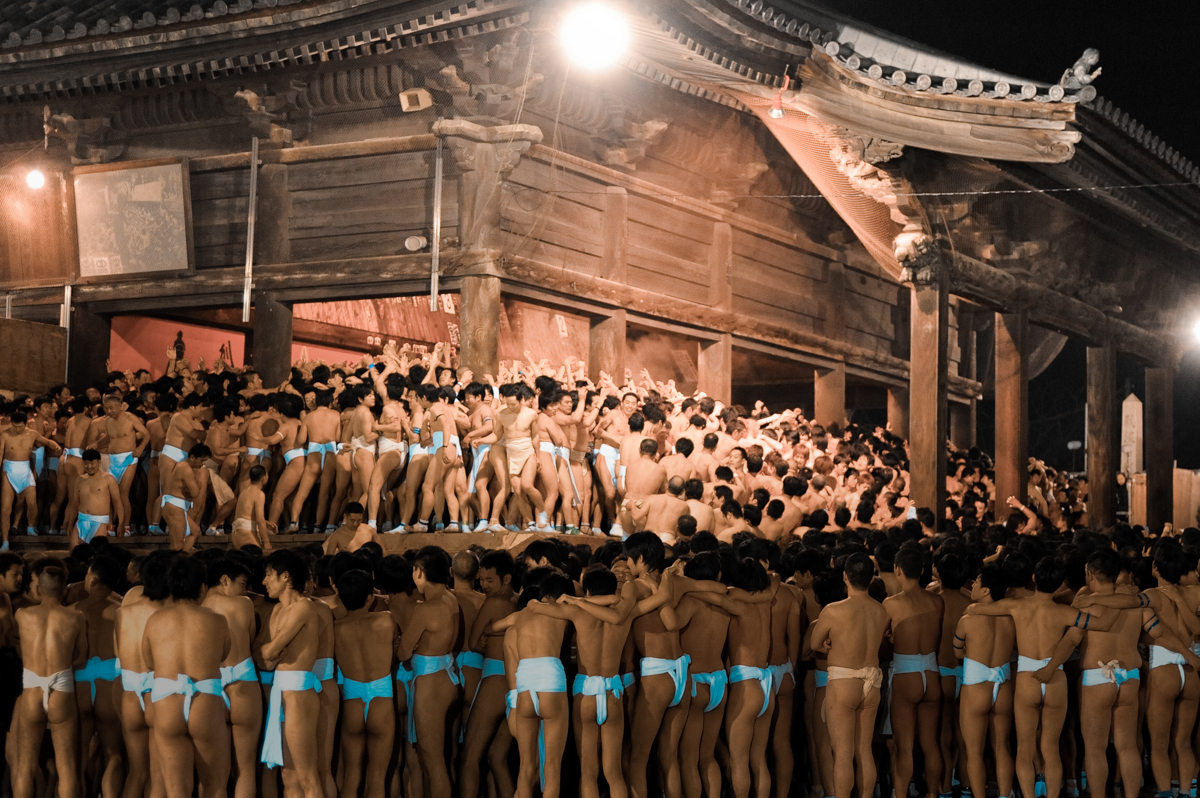
At Saidaiji Kannon-in temple in eastern Okayama City, on the third Saturday of February each year, a ceremony unfolds that connects the present moment to a continuous chain of religious observance reaching back to the Nara period. The Saidaiji Eyō — known in popular culture as one of the three great eccentric festivals of Japan — is the culminating event of the temple's annual Shushōe: a fourteen-day New Year purification rite of ancient origin. Its present form as a naked festival dates according to temple tradition to the year 1510, when the then-abbot Chūa distributed protective amulets to assembled worshippers, who scrambled for them with such intensity that participants stripped bare for freedom of movement and purified themselves with cold water to approach the sacred objects in a state of physical purity. Today, on the night of the third Saturday of February, tens of thousands of worshippers fill the temple precinct. At a precise moment near midnight, a pair of sacred wooden rods — the shingi — are cast from the inner window of the main hall into the crowd below. What follows is a massive, ecstatic, bare-chested scramble as thousands of fundoshi-clad men press and surge to claim the shingi. The man who secures a shingi and presents it at the inner hall is declared the year's most fortunate man. All of this is preceded by three weeks of preparatory rites, including the gathering of the shingi's wood, its ceremonial shaping, and the full fourteen-day Shushōe. Women dressed in white also perform cold-water purification on the precinct grounds, and the Eyō Taiko — the drum that announces the festival's opening — is played exclusively by women.
H I G H L I G H T S
Highlights
- 01At midnight, a pair of sacred wooden rods (shingi) are cast from the inner window of the main hall into a crowd of tens of thousands of bare-chested men — the scramble that follows, a surging mass of fundoshi-clad bodies under winter darkness, is one of the most visually extraordinary ceremonies in the Japanese religious calendar.
- 02The Eyō Taiko — the drum that announces the opening of the ceremony — is performed exclusively by women in white; female participants also conduct cold-water purification on the precinct grounds, making the Eyō a ceremony in which feminine liturgical agency is structurally central rather than incidental.
- 03A national Important Intangible Folk Cultural Property with a documented history running from the Nara period Shushōe through the pivotal 1510 transformation to the present day, the Saidaiji Eyō represents one of the most historically layered and liturgically complex ritual assemblies in Japanese folk religion.
D E E P D I V E