F E S T I V A L / FEST-093
Yaeyama Angama
八重山のアンガマやえやまのあんがま
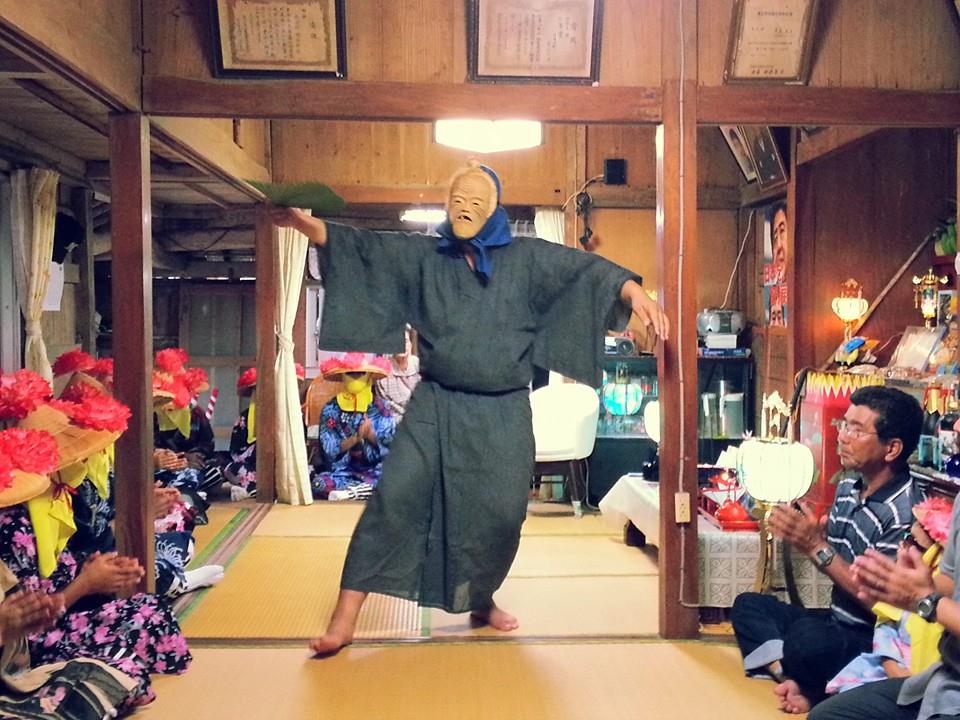
During the three days of Obon in the seventh lunar month, the island communities of the Yaeyama Archipelago — Ishigakijima, Taketomijima, Iriomotejima, Kohama Island, Kuroshima, and others — receive their ancestors. The Angama is a kami visitation rite of the Okinawan Obon tradition in which the ancestral dead are embodied by masked figures and return to visit the homes of their descendants. The principal figures are Ushūmai (the Old Man of the Other World) and Nmī (the Old Woman of the Other World), whose masks represent the faces of the visiting dead; they are accompanied by a troupe of young men and women designated Fāmā (Children of the Other World), who provide music on the sanshin (three-stringed lute), dance, and assist in conducting an exchange of witty, philosophically-tinged dialogue between the masked ancestors and the living family members who receive them. This dialogue — in which questions about life in the Other World alternate with commentary on the household being visited — is understood as both entertainment and genuine communication between the realms of the living and the dead. The Angama is a community-internal observance: access for outside observers depends entirely on the permission of the household and community involved, and varies by island, by settlement, and by year.
H I G H L I G H T S
Highlights
- 01Masked figures representing the ancestral dead — Ushūmai (Old Man of the Other World) and Nmī (Old Woman of the Other World) — move house to house during Obon, accompanied by young musicians and dancers; the rite embodies the Okinawan and Ryūkyūan ancestral faith that the dead remain in active communication with the living.
- 02The dialogue between the masked ancestors and the living family members — alternating philosophical humor with genuine emotional weight — is a form of religious theater found almost nowhere else in Japan; its survival in the Yaeyama communities reflects the depth and distinctiveness of Ryūkyūan folk religious tradition.
- 03As a house-to-house community rite in remote island communities, the Angama is among the most restricted of Japan's major folk religious practices from the standpoint of outside access; approaching it requires advance permission from local community councils and a willingness to observe strictly within the terms set by the community.
D E E P D I V E