F E S T I V A L / FEST-069
Awashima-Konsei Festival (Union of the Female and Male Deities)
あわしま・こんせい祭あわしま・こんせいまつり
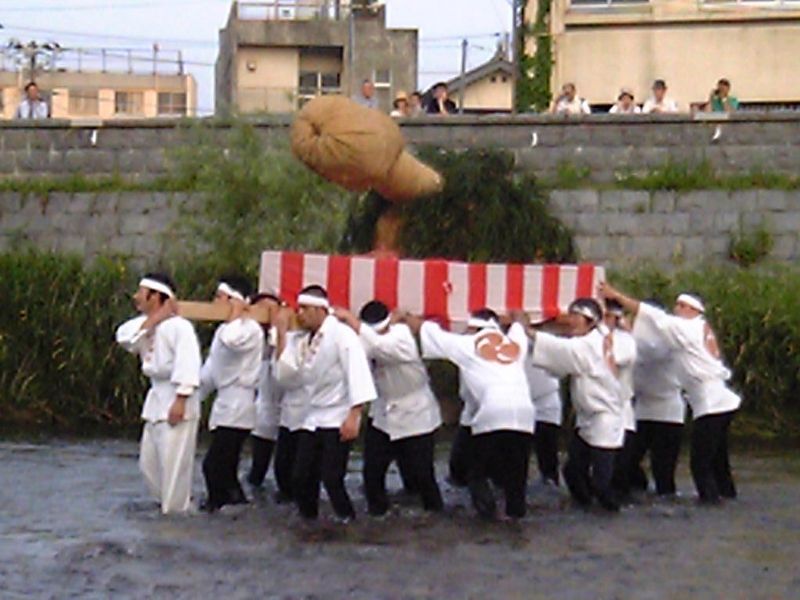
In the heart of Morioka City — at a specially designated ceremonial ground within Kōdōji Park, on the site of the former Morioka Castle — a festival combining two ancient currents of Japanese vernacular religious practice is conducted annually in late July. The Awashima-Konsei Festival is organized by the Awashima-Konsei Festival Promotion Society, based at Morioka Kaiun Shrine. Its ceremonial center is the Maguai no Gi — the "rite of sacred union" — in which the o-mikoshi (portable shrine palanquins) of Awashima-sama, a female deity associated with women's health, childbirth, and matrimonial blessing, and Konsei-sama, a male deity embodying phallic generative force particularly venerated across the Tōhoku region, are ceremonially brought together. The union of these two deities is understood as a prayer for the continuity of life, the blessing of descendants, the formation of harmonious unions, and the peace and prosperity of the community. The festival program includes the installation of the palanquins, an opening ceremony, a dedication of the Takino-shita Sansa dance — a form associated with Morioka's traditional performing arts — the main religious rite, the Maguai no Gi procession, a community peace-and-prosperity prayer, and a communal closing banquet.
H I G H L I G H T S
Highlights
- 01The ceremonial union of the palanquins of Awashima-sama (female deity) and Konsei-sama (male deity) — the Maguai no Gi — forms the rite's ritual center: a visual and liturgical affirmation of the generative complementarity at the heart of Japan's agricultural and reproductive folk belief.
- 02The festival takes place within Kōdōji Park, on the former grounds of Morioka Castle, combining an urban public setting with the intimate scale of a community devotional gathering — a quality that distinguishes it from the large-scale fertility festivals of other prefectures.
- 03The Awashima cult (female deity, protector of women's health and childbirth) and the Konsei cult (male deity, phallic agricultural prayer) represent two of the oldest and most geographically widespread vernacular religious traditions in Japan; this festival is a rare instance of their ceremonial synthesis in a single urban event.
D E E P D I V E