F E S T I V A L / FEST-067
Urasa Bishamondō Naked Pressing Festival (Hadakaoshi-ai Taisai)
浦佐毘沙門堂裸押合大祭うらさびしゃもんどうはだかおしあいたいさい
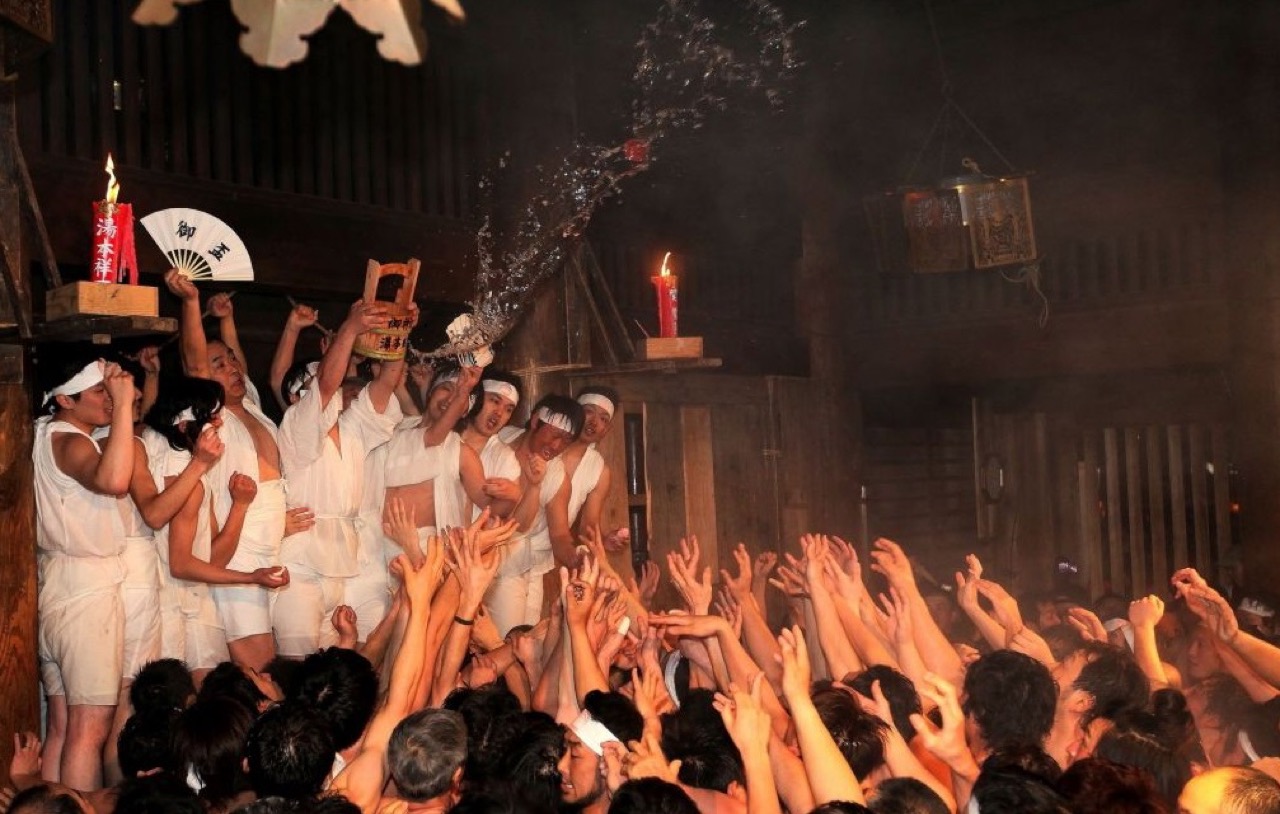
On the first Saturday of March each year, a ceremony reputed to span some twelve hundred years unfolds at Fūkōji temple in Urasa, Minami-Uonuma — a city of deep snows in inland Niigata — at the Bishamondō hall devoted to Bishamonten, the Buddhist guardian of warriors and fortune. Ranked among the three great eccentric festivals of Japan and designated a national Important Intangible Folk Cultural Property, the Urasa Bishamondō Hadakaoshi-ai Taisai is said to originate in a celebratory gathering held by the Heian general Sakanoue no Tamuramaro after he erected the hall in the early ninth century. Devotees competing to be first before Bishamonten began pressing against one another in the approach; cold-water ablution added a penitential purification; and participants gradually stripped bare for freedom of movement. Today the festival unfolds over two days: a solemn Friday-night vigil featuring dedication of a great candle weighing more than thirty kilograms and water ablution by the Tamon Youth Group, followed by the Saturday festival in which ablution participants carry the enormous candle to the Bishamondō to the cry of "Sanyo, sanyo!" Inside, young men at the inner sanctuary hurl wooden prayer-tallies and lucky rice cakes into the crowd below; hundreds of bare-chested men press violently against one another, for only those pushed to the very front may enter the inner sanctuary to pray before Bishamonten himself.
H I G H L I G H T S
Highlights
- 01A great candle weighing over thirty kilograms is carried through the snowy precinct by bare-chested men crying "Sanyo, sanyo!" — a visually extraordinary procession in full winter darkness in one of Japan's heaviest snowfall zones.
- 02Inside the Bishamondō hall, hundreds of participants press against one another in an ecstatic contest for position; the ambient heat, noise, and physical density create an atmosphere unlike any other religious ceremony in Japan.
- 03Designated a national Important Intangible Folk Cultural Property and counted among the three great eccentric festivals of Japan, this ceremony preserves a direct link to Bishamonten devotionalism and the cult of the general Sakanoue no Tamuramaro across roughly twelve centuries of continuous practice.
D E E P D I V E